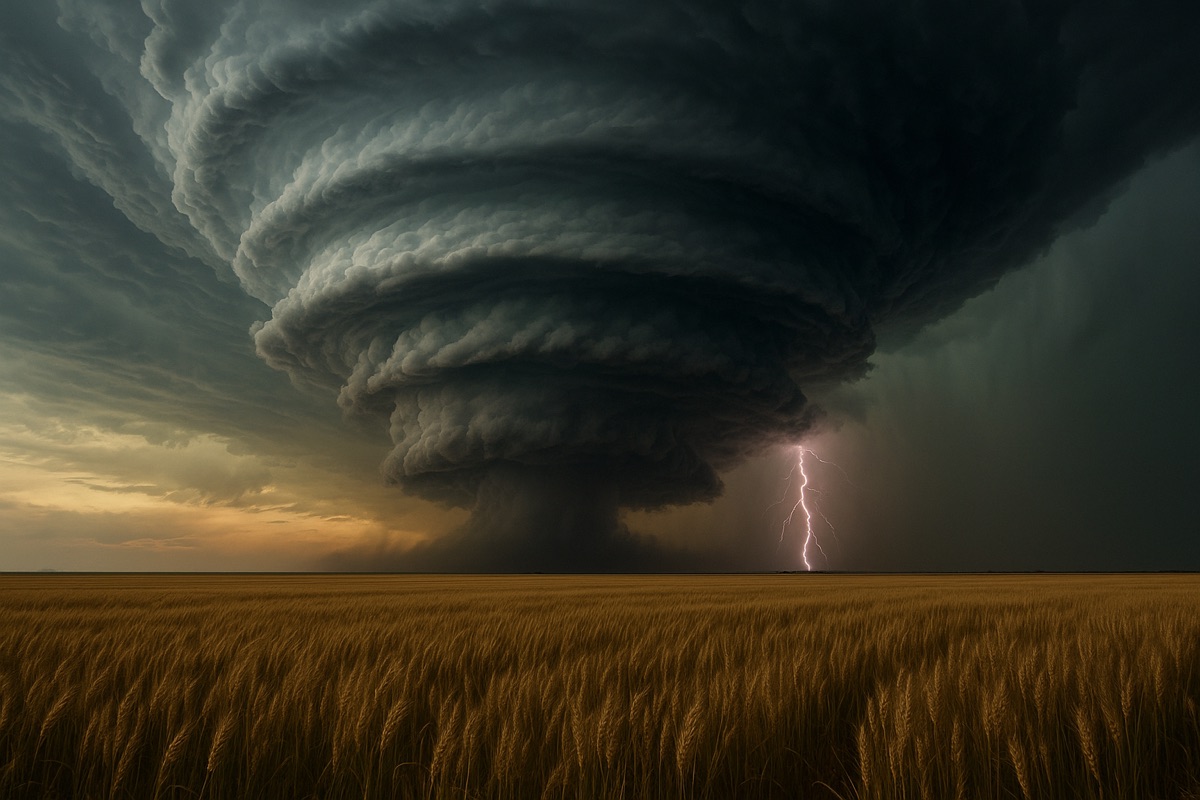
Weather trivia has an unfair edge over every other category: the subject is trying to kill you, and it's happening right now, somewhere, in numbers that sound invented. None of these are invented. Commit to each answer before the reveal, keep score, and check the radar on your way out.
Round One: Lightning, the Overachiever
Start hot. How does the temperature of a lightning bolt compare to the surface of the sun? Lock in a guess. A bolt can heat the air around it to roughly 50,000 degrees Fahrenheit — about five times hotter than the sun's surface. The thunder you hear is that superheated air expanding violently, which is why the old counting trick works: about five seconds between flash and boom per mile of distance.
Now the myth everyone learned in a backyard: does lightning really never strike the same place twice? Emphatically no. The Empire State Building alone is struck around twenty times or more in a typical year. And the human record makes the point even harder: U.S. park ranger Roy Sullivan was struck by lightning seven separate documented times between 1942 and 1977 — and survived every one. Lightning not only strikes twice; it apparently holds grudges.
Scale question: how often does lightning strike worldwide? On the order of tens of flashes every second — well over a billion flashes a year across the planet. While you read this paragraph, the Earth got hit hundreds of times.
And 'heat lightning,' those silent summer flickers on the horizon? There's no such separate phenomenon — it's ordinary lightning from a storm too far away for the thunder to reach you. The storm is real; it's just somebody else's problem.
Round Two: The Records Board
Hottest air temperature ever reliably measured on Earth — where and how hot? The official record is 134°F at Furnace Creek in Death Valley, California, set in 1913. Here's the honest hedge, though: some weather historians dispute that century-old reading, and if it ever fell, the crown would pass to — Death Valley again, which hit an undisputed 130°F in both 2020 and 2021. Either way, the answer is Death Valley; the only argument is by how much.
Now flip the thermometer. Coldest? The ground-station record is −128.6°F at Vostok Station, Antarctica, in 1983. Satellites have since detected pockets of the East Antarctic ice sheet dipping even lower, but for an actual thermometer at an actual station, Vostok still stands — a temperature at which steel can turn brittle and boiling water thrown into the air freezes before it lands.
Hail question, and it's a beauty: how big was the largest hailstone ever recovered in the United States? Eight inches across — bigger than a volleyball is wide — weighing just under two pounds, fallen on Vivian, South Dakota in 2010. It reportedly left a crater in the ground. Globally, a 1986 storm in Bangladesh dropped stones weighed at around two and a quarter pounds, among the deadliest hail events ever recorded.
Bonus round, no charge:
What shape is a falling raindrop?
Not a teardrop. Small drops are nearly spherical, and larger ones flatten on the bottom into something like a hamburger bun. The teardrop is pure clip art.
Wind to finish the round. For decades the fastest wind gust ever measured was 231 mph atop Mount Washington, New Hampshire, in 1934 — still the Western Hemisphere record. But the world title moved in 1996, when Tropical Cyclone Olivia pushed a 253 mph gust past an anemometer on Barrow Island, Australia. And if you allow radar instead of instruments on poles, a Doppler unit measured winds around 300 mph inside the tornado that struck the Oklahoma City area in May 1999 — the fastest winds ever observed on Earth.
Round Three: Wettest, Driest, and Most Tornado-Prone
Rainfall first. What is generally cited as the wettest inhabited place on Earth? Mawsynram, in the hills of northeastern India, averaging somewhere around 470 inches of rain a year — nearly forty feet. Residents weave full-body umbrella shields out of bamboo to work outdoors in monsoon season, which is the most reasonable possible response.
Driest? The Atacama Desert in Chile, where some weather stations have gone years without measurable rain, and parts of which rank among the driest ground on the planet outside the polar regions. There are Atacama hillsides that get their only reliable moisture from fog.
Last one, close to home: which country records the most tornadoes per year? The United States, and it isn't close — roughly 1,200 in an average year, more than any other country on Earth, thanks to the continent-sized collision zone where cold, dry air from Canada meets warm, wet air from the Gulf. Tornado Alley isn't a nickname; it's plumbing.
Add up your score. If you got Death Valley twice, the seven-strike park ranger, and the volleyball-class hailstone, you're officially the person your group chat should consult before every road trip — and the only one who knows the teardrop has been a lie all along.