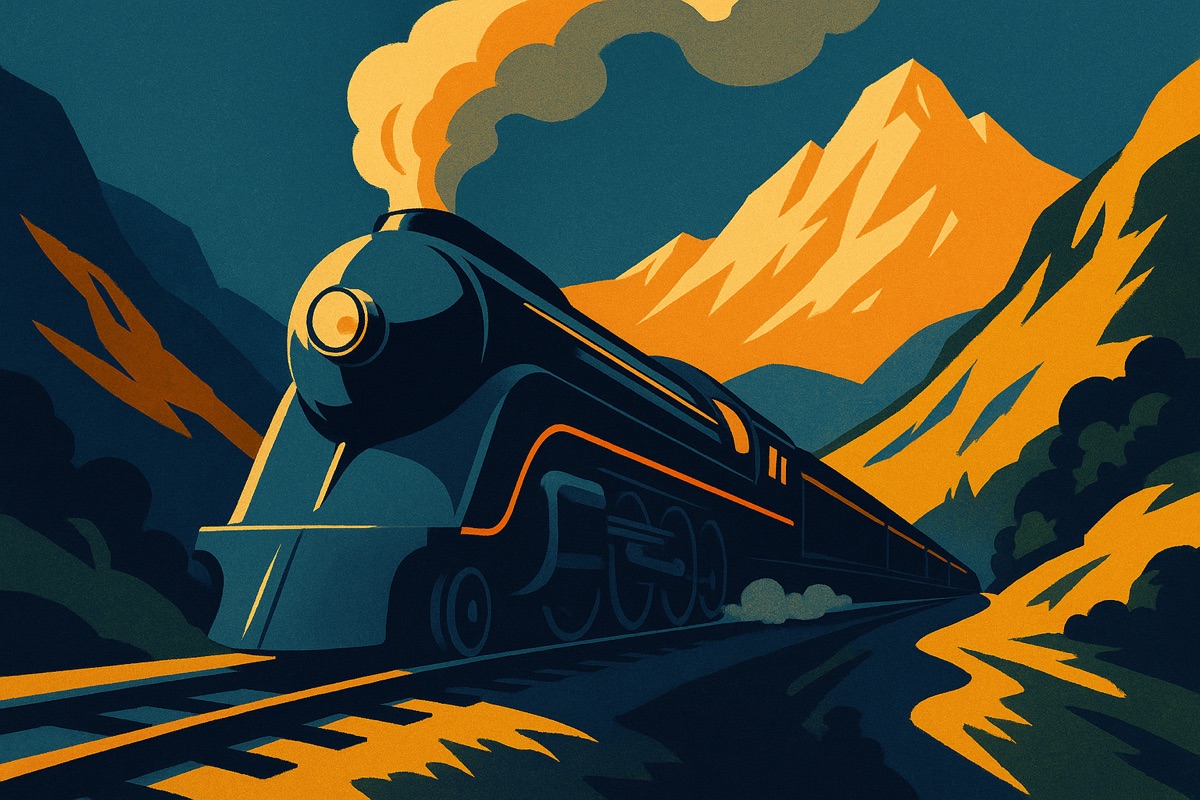
Railways didn't just move people — they standardized the width of the world and, in a very real sense, invented the time on your phone. This round rolls from a week-long Russian epic to a French speed run that still hasn't been beaten on rails. All aboard; answers out loud before each reveal.
Round One: The Long Way Around
Start with the giant. What is the longest railway line in the world? The Trans-Siberian, running from Moscow to Vladivostok — roughly 5,800 miles of track, a journey of about a week if you ride it straight through, crossing so much of Russia that your watch ends up seven hours ahead of where it started. It is the only train ride on Earth where jet lag is a legitimate concern.
Now rewind to the beginning. What was the world's first public railway to use steam locomotives, opened in England in 1825? The Stockton and Darlington Railway, with George Stephenson's engine Locomotion No. 1 doing the pulling. Four years later came the audition that changed everything: the Rainhill Trials of 1829, a public locomotive competition won decisively by Stephenson's Rocket, whose basic layout set the pattern for steam engines for the next century. The railway age began, quite literally, with a contest.
One more distance question. Where did America's first transcontinental railroad famously meet in 1869? Promontory Summit, Utah, where the rails built east from Sacramento met the rails built west from Omaha and a ceremonial golden spike joined them. A coast-to-coast journey of months shrank to about a week — the single greatest shipping upgrade in American history until someone invented the cardboard box.
Round Two: Gauge Wars and Speed Runs
Here's a number worth knowing cold: what is the width of standard railway gauge? Four feet, eight and a half inches — an oddly specific figure now used on most of the world's track. Where does it come from? You may have heard the internet's favorite answer: Roman chariot ruts, handed down through the ages. The honest version is less romantic — historians treat that story as a tall tale. The gauge descends from the horse-drawn wagonways of the English coal country that George Stephenson worked on; his railways used it, his railways won, and the rest of the world largely fell in line. Standard gauge isn't ancient wisdom. It's momentum.
Now the speed round. What is the fastest a train has ever gone on conventional rails? In 2007, a specially prepared French TGV hit 357 miles per hour — a record on steel wheels that still stands. Japan answered in 2015 in a different category entirely: a maglev test train, floating on magnets rather than rolling, reached 375 miles per hour. And if you want to ride something like that speed today, the Shanghai maglev has whisked airport passengers at up to about 268 miles per hour — covering its route in under eight minutes and making every taxi on the adjacent highway look parked.
Round Three: The Trains That Invented Time
Before railroads, how did towns set their clocks? By the sun — every town kept its own local noon, which meant neighboring cities could disagree by a few minutes and nobody cared. Then trains made minutes matter, because a schedule kept in dozens of local times is a puzzle at best and a collision at worst. Britain's railways solved it early, spreading standardized "railway time" based on Greenwich in the 1840s, decades before the country made it official.
So here's the centerpiece question: what happened in the United States on November 18, 1883? The railroads switched the continent to standard time zones — the ancestors of Eastern, Central, Mountain, and Pacific — and towns across the country reset their clocks to match. It's remembered as "the day of two noons," because in many places the local solar noon passed, and then, minutes later, the railroad's new noon arrived and the clocks struck twelve again. Congress didn't get around to making zone time federal law until 1918. For thirty-five years, the time in America was, in effect, whatever the railroads said it was.
Two quick stops before the terminus. Which New York landmark holds more platforms than any other train station in the world? Grand Central Terminal, with 44 of them spread across two underground levels. And the man who championed a worldwide system of hour-wide time zones, Sandford Fleming, was a railway engineer from which country? Canada — he pushed the idea after missing a train over a misprinted schedule, proving that all great standards are born of great annoyance.
End of the line — tally up. If you called the wagonway gauge, the day of two noons, and the 357 mph TGV, you may consider yourself the conductor of any trivia table you board.