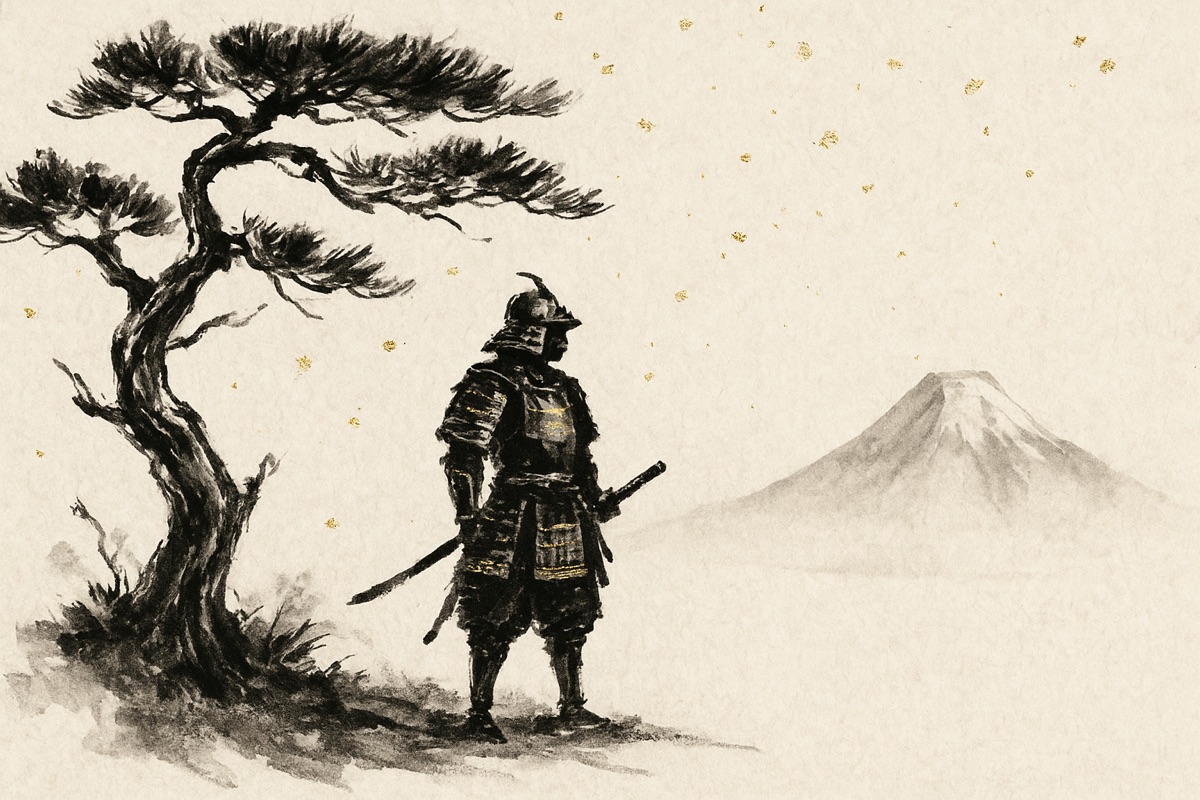
Most of what you know about samurai arrived by way of a movie, which means about half of it is wrong in genuinely interesting ways. Thirteen questions follow. Commit before each reveal, keep score, and no partial credit for 'the Hollywood version.'
Round One: The Job Description
Start with the word itself. What does 'samurai' literally mean? Lock it in. It comes from the verb saburau — 'to serve.' Not 'warrior,' not 'sword-bearer.' Servant. The men who became history's most mythologized fighters were, by their own name, attendants to a lord first.
Next, the one that ruins film posters: what was the samurai's primary battlefield weapon for most of their history? Not the katana. Early samurai lived by kyūba no michi — 'the way of the bow and horse' — and were mounted archers above all; in the massed battles of later centuries, the spear did the heavy work. The katana was a sidearm and a status symbol, the era's equivalent of an officer's pistol.
Speaking of status: what two items, worn together, legally marked a man as samurai? The daishō — the long katana paired with the short wakizashi. Under Edo-period law, only samurai could wear both. The swords were less a weapon system than an ID badge you could be executed for faking.
Now, did the samurai scorn firearms as dishonorable? They did not. After Portuguese traders landed in 1543, Japan copied the matchlock and manufactured it with alarming enthusiasm — by some estimates becoming one of the most gun-saturated countries on Earth within decades. Guns helped decide the battle of Nagashino in 1575, wielded by armies full of men with topknots.
One more: which arts was a proper samurai expected to master besides fighting? Poetry, calligraphy, and often the tea ceremony — many composed a farewell poem, a jisei, in anticipation of death. Try to imagine a modern military requiring publishable verse.
Round Two: Names Worth Knowing
The chronicles of the 12th-century Genpei War describe a female warrior 'worth a thousand men,' famed for archery and horsemanship. Name her. That's Tomoe Gozen — the most celebrated of the onna-musha, the women warriors the movies keep forgetting existed.
Harder one. In 1581, the warlord Oda Nobunaga took a foreign-born man into his service as a warrior, granting him a stipend and a sword. Where was he from? Africa. Yasuke arrived in Japan with Jesuit missionaries and, per period chronicles, fought in Nobunaga's retinue — a story so improbable it took four centuries for popular culture to catch up.
Next: which swordsman claimed sixty-odd duels without a loss, reportedly showed up late on purpose to rattle opponents, and — as the legend goes — won his most famous duel with a wooden sword carved from an oar? Miyamoto Musashi, who then retired to a cave and wrote The Book of Five Rings, a strategy manual that still haunts business-school reading lists.
Finish the round with the national epic. In 1701, a lord was ordered to commit seppuku after drawing his blade on an official inside Edo Castle. What did his leaderless retainers do next? They waited nearly two years, then avenged him — the 47 rōnin, who accepted their own death sentences afterward and became Japan's most retold loyalty story.
Round Three: How It Ended
During the Edo period's long peace, what did most samurai actually do all day? Paperwork. Two largely warless centuries turned a warrior caste into administrators and clerks, paid stipends measured in koku of rice — history's best-armed middle managers, making up roughly 6 to 7 percent of the population with their families.
Then it ended fast. What did the 1876 Haitōrei edict ban? Wearing swords in public. After roughly 700 years, the badge of the class became contraband almost overnight. The following year came the last stand: the Satsuma Rebellion of 1877, led by Saigō Takamori — the real 'last samurai,' who died in the final battle, was posthumously pardoned, and now stands as a beloved statue in Tokyo's Ueno Park.
Final question, and it's the quiet twist: when did the famous samurai code become world-famous as 'bushido'? Largely in 1900 — after the samurai were gone — when Nitobe Inazō published Bushido: The Soul of Japan, written in English for Western readers. The code as most people know it is partly a eulogy.
Count your points. If you knew the bow outranked the katana, knew Yasuke, and caught that bushido's bestseller era began after the last samurai fell, you've out-argued the movies — swords down, score up.