The era we call the Wild West lasted barely three decades — and has now spent five times that long being rewritten by dime novels and movie studios. Which makes it perfect quiz territory, because the truth is stranger, quieter, and occasionally more Russian than the legend. Three rounds, difficulty climbing. Say each answer out loud, keep score, and holster your assumptions.
Round One: Thirty Seconds in a Vacant Lot
Begin with the most famous gunfight in American history. How long did the shootout at the O.K. Corral actually last? Lock it in. About thirty seconds. On October 26, 1881, in Tombstone, Arizona, the Earp brothers and Doc Holliday traded roughly thirty shots with the Clantons and McLaurys; three men died, and the whole affair was over before a kettle could boil. Now the follow-up nobody sees coming: it didn't happen at the O.K. Corral. The fight broke out in a narrow vacant lot off Fremont Street, several doors away — but "Gunfight at the O.K. Corral" sounded better, and once Hollywood put the phrase on a marquee, the geography never stood a chance.
What was the dispute even about? In meaningful part: gun control. Tombstone had an ordinance requiring visitors to check their firearms while in town, and the Earps confronted the cowboys that afternoon partly for going armed in violation of it. Many cattle towns kept similar rules. The era's most famous shootout began, at bottom, as a weapons-check enforcement action.
One more from Tombstone's cast, because legends have a habit of outliving their era. When and where did Wyatt Earp die? Lock it in. In 1929 — in Los Angeles, in the age of automobiles, radio, and talking pictures. He spent his final years around Hollywood advising on silent Westerns, and cowboy stars of the silent screen helped carry his casket. The frontier's most famous lawman outlived the frontier by four decades and was buried by the movie business that mythologized him.
Round Two: The Workforce Nobody Filmed
Where does the cowboy's whole toolkit come from? Mexico. The lariat (from la reata), the rodeo, the ranch, even "buckaroo" — an English mangling of vaquero — all descend from the Mexican horsemen who invented the trade. And the workforce looked nothing like the movie posters: historians estimate that roughly one cowboy in four was Black, with many more Mexican and Native American riders besides. The most American icon there is was always a multicultural gig run on borrowed equipment.
Wardrobe check, quickly. John B. Stetson's "Boss of the Plains" — the original cowboy hat — went on sale in 1865, and in 1873 Levi Strauss and tailor Jacob Davis patented riveted work trousers, known ever since as blue jeans. The frontier's two most enduring conquests turned out to be fashion.
Now the business round. How long did the Pony Express actually operate? Commit to a number. About eighteen months — April 1860 to October 1861 — before shutting down, a money-loser to the end, just two days after the transcontinental telegraph clicked to life. One of the most mythologized institutions in American history ran shorter than most phone contracts.
And the round's curveball: true or false — the U.S. Army once deployed camels in Texas. True. The 1850s Camel Corps, championed by then–Secretary of War Jefferson Davis, imported dozens of camels to haul freight across the Southwest, and by most accounts they performed admirably. The Civil War scuttled the experiment, the herds were sold off or scattered, and startled travelers reported feral camels wandering the desert for decades afterward.
Round Three: The Frontier Fact-Check
How common were bank robberies in the Old West? Pick a number and lock it in. One historian who combed the records found only about a dozen documented bank heists across some forty years of the frontier era — banks sat in the middle of town, often sharing a wall with well-armed neighbors, and robbing one was closer to suicide than strategy. The cinematic staple was, in reality, a rounding error.
Next, cards. What was Wild Bill Hickok holding when he was shot in Deadwood in 1876? By tradition, two pair — black aces and black eights — known ever since as the dead man's hand. (The fifth card, fittingly, is disputed.) And the era's deadliest gambler, Doc Holliday? His actual profession was dentistry — he earned a dental degree in 1872 before tuberculosis sent him west to the card tables.
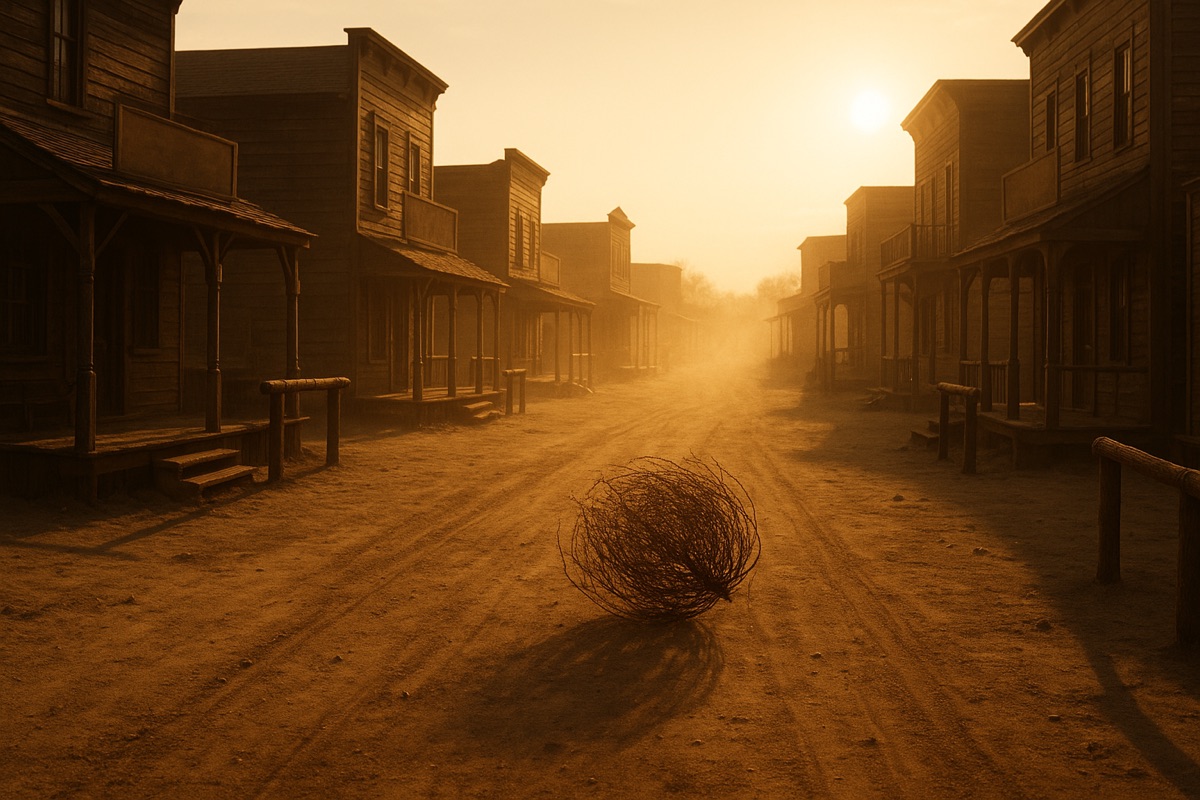
Final question, and the whole article has been building to it. The tumbleweed — that lonesome ball of brush rolling through every Western ever filmed. Where is it actually from? Lock it in. Russia. The tumbleweed is Russian thistle, which turned up in South Dakota in the 1870s — most likely a stowaway in flax seed shipped from the steppes — and rolled its way across the entire West within a few decades, arriving just in time to be filmed as the very symbol of the American frontier. The most American prop in cinema is an immigrant that showed up as the frontier was closing.
Tally your score. If you called the thirty-second gunfight, the eighteen-month Pony Express, and the Russian tumbleweed, congratulations: you're now the designated fact-checker for every Western on movie night — a lonely job, but somebody has to ride it.