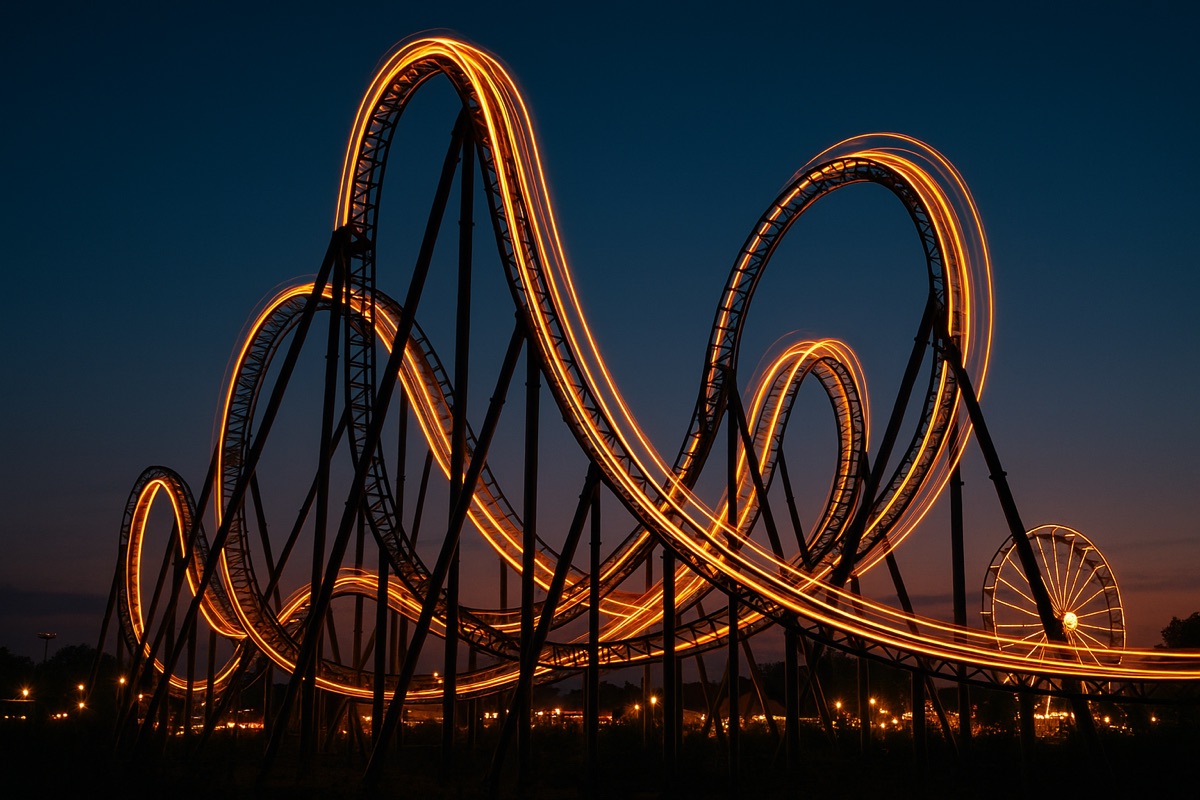
Roller coasters are the rare machines built for no purpose except feelings. Fittingly, this quiz is shaped like one: a slow climb, a regrettable middle, and a screaming finish. Commit to each answer before the reveal, keep score, and no grabbing the safety bar.
Round One: Before the Steel
Start at the very beginning. What were the ancestors of the roller coaster made of? Lock it in. Ice. Russians of the 1600s and 1700s built towering wooden ramps in winter, froze the chutes solid, and shot down them on sleds — thrill rides centuries before anyone thought to charge admission properly.
That origin is fossilized in language, and here's the version that wins bar bets. What do the French call a roller coaster? Montagnes russes — 'Russian mountains.' And what do Russians call one? 'American mountains.' Two languages, each politely pointing at the other side of the world, neither taking credit.
Now cross the Atlantic. Where and when did America's first true coaster open? Coney Island, 1884 — LaMarcus Thompson's Switchback Railway. Top speed: about six miles per hour. Price: a nickel. It reportedly earned back its construction cost within weeks, establishing the industry's founding principle — people will pay good money to be mildly alarmed.
One more for the preservationists. The oldest roller coaster still running opened in 1902. Where is it? Lakemont Park in Altoona, Pennsylvania — Leap-the-Dips, a gentle wooden antique that's now a National Historic Landmark you can still ride.
Round Two: The Physics Round
Trick question, and answer honestly: how many engines does a typical roller coaster carry on board? Zero. Once the chain hauls the train up that first hill — or a launch system flings it — the entire ride is gravity and momentum doing unpaid work. A roller coaster is a falling machine with excellent manners.
So what actually keeps the train from flying off the track? The answer is a name worth knowing: John Miller, the engineer who patented underfriction wheels in 1919. His design grips the rail from above, below, and the side — three sets of wheels locking the train on. Nearly every coaster you've ever ridden runs on his idea.
Next: why are vertical loops teardrop-shaped instead of circular? Because the circle was tried, and the circle lost. Coney Island's Flip Flap Railway ran a perfectly round loop in 1895 and subjected riders to something like 12 g — enough to strain necks and end careers. Modern loops use a clothoid curve, tighter at the top and flared at the bottom, which spreads the forces out. The first modern vertical-loop coaster, the Revolution at Six Flags Magic Mountain, didn't arrive until 1976 — eighty years of engineers side-eyeing the loop before someone solved it.
Last one this round: what did Disneyland's Matterhorn Bobsleds introduce in 1959 that changed everything? The first tubular steel track. Wood flexes only so far; steel tubes can corkscrew. Every inverting, twisting monster built since is that mountain's descendant.
Round Three: The Record Board
Fastest coaster on Earth? Formula Rossa at Ferrari World in Abu Dhabi — roughly 149 miles per hour, launched so hard that riders are issued goggles, because at that speed an insect is a projectile.
Tallest ever built? Kingda Ka in New Jersey — 456 feet, a hydraulic launch to 128 mph in about three and a half seconds. It held the height crown from 2005 until 2025, when the park demolished it, proving that even records eventually get torn down on purpose.
Longest? Steel Dragon 2000 in Japan, at about 8,100 feet — a mile and a half of track, named for the Year of the Dragon in which it opened.
And the most loops, rolls, and other upside-down moments on a single ride? The Smiler at England's Alton Towers, with 14 inversions — a world record with a name that reads like a threat.
Tally it up. If you called the ice slides, the zero engines, and the reason loops stopped being circles, you rode this one with your hands in the air — and you're now legally obligated to explain clothoid curves in the queue line.