Here's the strange truth about pirate trivia: the real Golden Age of Piracy — roughly the 1650s through the 1720s, peaking in the decade after 1715 — was in many ways stranger than the movie version, just in the opposite direction. Less plank-walking, more paperwork. Fewer buried chests, better health benefits. Keep score as you go, and prepare to have Hollywood's entire pirate mythology keelhauled by the historical record.
Round One: The Paperwork of Piracy
Start with the question that reframes everything. Before a voyage, what did pirate crews typically sign? A written set of rules — the ship's articles — laying out how loot would be split, how disputes would be settled, and what got you punished. Pirates, the supposed enemies of all order, ran their ships on contracts.
It gets better. How did a pirate crew typically choose its captain? They voted. And they could vote him out again if he disappointed — the captain often held absolute authority only in battle, with a quartermaster elected as a counterweight the rest of the time. Many pirate ships were, functionally, small floating democracies operating decades before the American and French revolutions made the idea fashionable on land.
Now the fact that wins the round: what did many pirate articles promise a crewman who lost a limb or an eye in action? Compensation — a fixed payout from the common loot, scaled to the injury. That's workers' compensation, on a pirate ship, in the 1700s. Sign here, initial there, welcome aboard.
For flavor, take the surviving articles of Bartholomew 'Black Bart' Roberts, the most successful pirate of the age with some 400 ships captured: lights out at eight o'clock, no gambling for money aboard ship, and the musicians got the Sabbath off. He was also famously said to prefer tea to rum. The deadliest pirate of the Golden Age ran a tight, tea-drinking, early-to-bed operation — remember that next time a movie shows you round-the-clock rum chaos.
Round Two: Myths Overboard
Time to sink some legends. How common was walking the plank? Barely documented at all — historians have found only a stray case or two, well outside the Golden Age's heyday. Real pirates who wanted someone dead had faster methods; the plank is essentially a creation of storybooks and cinema that outgrew its sources.
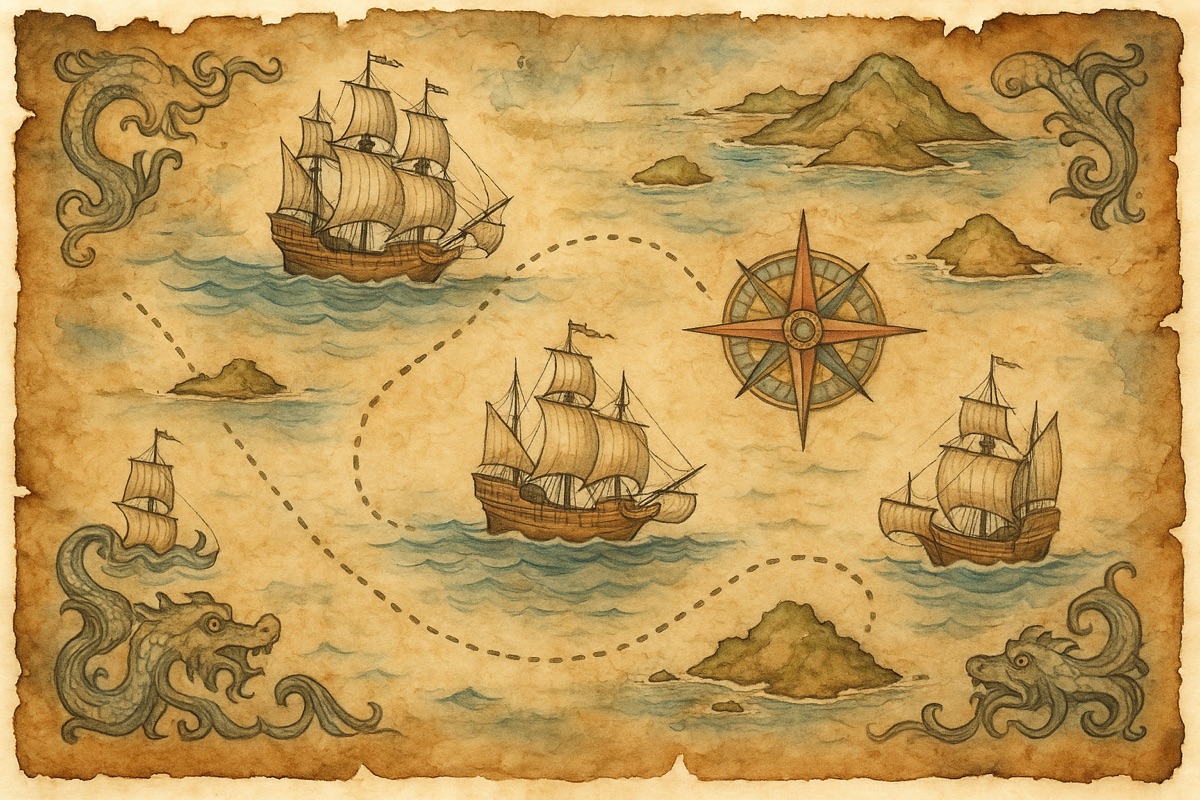
Next: did pirates bury their treasure? Almost never. Most loot wasn't gold anyway — it was cargo: cloth, sugar, medicine, rope, whatever could be sold or used — and pirates spent their shares fast, in port, on exactly what you'd guess. The legend traces heavily to one man, Captain William Kidd, who really did stash some treasure on Gardiners Island off New York before his arrest in 1699. One buried cache, one hanged pirate, three centuries of shovel-based fiction. The X-marks-the-spot treasure map, for the record, owes its fame to Robert Louis Stevenson's Treasure Island in 1883, not to any pirate's hand.
Now the one nobody sees coming: where does the 'pirate accent' come from — all that growling 'arrr, matey'? Not from the 1700s. It comes overwhelmingly from actor Robert Newton, who played Long John Silver in the 1950 film of Treasure Island and leaned gloriously hard into his native West Country English accent. Real pirate crews were a polyglot mix — English, African, Caribbean, Dutch, French — and no record suggests a shared pirate voice. Every talk-like-a-pirate impression on Earth is an impression of one actor having the time of his life.
As for eyepatches helping pirates keep one eye adapted to darkness below decks — it's a clever theory, and it's never been shown to be an actual pirate practice. The boring explanation, that sailors sometimes lost eyes, has the better paper trail.
Round Three: Blackbeard, Fact-Checked
The finale belongs to the most famous pirate of them all. First: what was Blackbeard's real name? Edward Teach — or Thatch; even the records disagree on the spelling. His flagship, the Queen Anne's Revenge, was a captured French slave ship he refitted with dozens of guns; its wreck was discovered off North Carolina in 1996 and has been yielding artifacts ever since.
His signature move? Before battle, he reportedly tucked slow-burning fuses under his hat and into his beard, wreathing his face in smoke — a walking special effect, engineered so enemies would surrender without a fight. And it worked, which sets up the twist: for all his demonic branding, there's no verified record of Blackbeard killing a single captive before his final battle. His most famous 'atrocity,' blockading Charleston in 1718, ended with him ransoming the port for a chest of medicine. The terror was largely theater — and the theater was the weapon.
The end came in November 1718 at Ocracoke Inlet, where Royal Navy lieutenant Robert Maynard's men killed him in close combat. And one last question to close the round: name the two women who sailed with 'Calico Jack' Rackham and fought harder, by witness accounts, than most of his crew. Anne Bonny and Mary Read — both convicted of piracy in 1720, and both escaped the gallows, at least initially, by revealing they were pregnant.
Final tally time. If you knew about the injury payouts, the one real buried treasure, and the 1950 accent, you've done something genuinely piratical: taken a ship full of treasured myths and left it stripped to the waterline.