Mythology trivia is a rigged game, and the house is Homer. The stories you think you know arrived through centuries of retellings, translations, and one very influential mistranslation — which means the best questions aren't about remembering the myths, they're about noticing where the myths you remember went sideways. Keep score. The Greeks would want you to be competitive about it.
Round One: Olympus Management
Warm up with the org chart. After the war against the Titans, three brothers divided the world by drawing lots. Zeus took the sky and Poseidon the sea — who got the underworld? Hades, whose reputation as a villain is mostly modern embellishment. In the original stories he's less evil overlord, more grim middle manager of an unglamorous department nobody else wanted.
Next: how was Athena born? Commit before the reveal, because this one is delightfully weird. She sprang from Zeus's head — fully grown and fully armored — after Zeus complained of a splitting headache and had his skull cracked open to relieve it. Goddess of wisdom, born from a headache. The myth logic checks out.
Now the mistranslation. What did Pandora actually open? If you said a box, you've been had by history. In the Greek original it was a large storage jar — a pithos. The scholar Erasmus is generally blamed for rendering it as a box in Latin centuries later, and the wrong container stuck. Same catastrophe, different packaging.
One more for this round: Hercules or Heracles? Both, technically — Heracles is the Greek name, Hercules the Roman one that Hollywood adopted. Under either name, he still owed the twelve labors.
Round Two: Monsters and Myth Logic
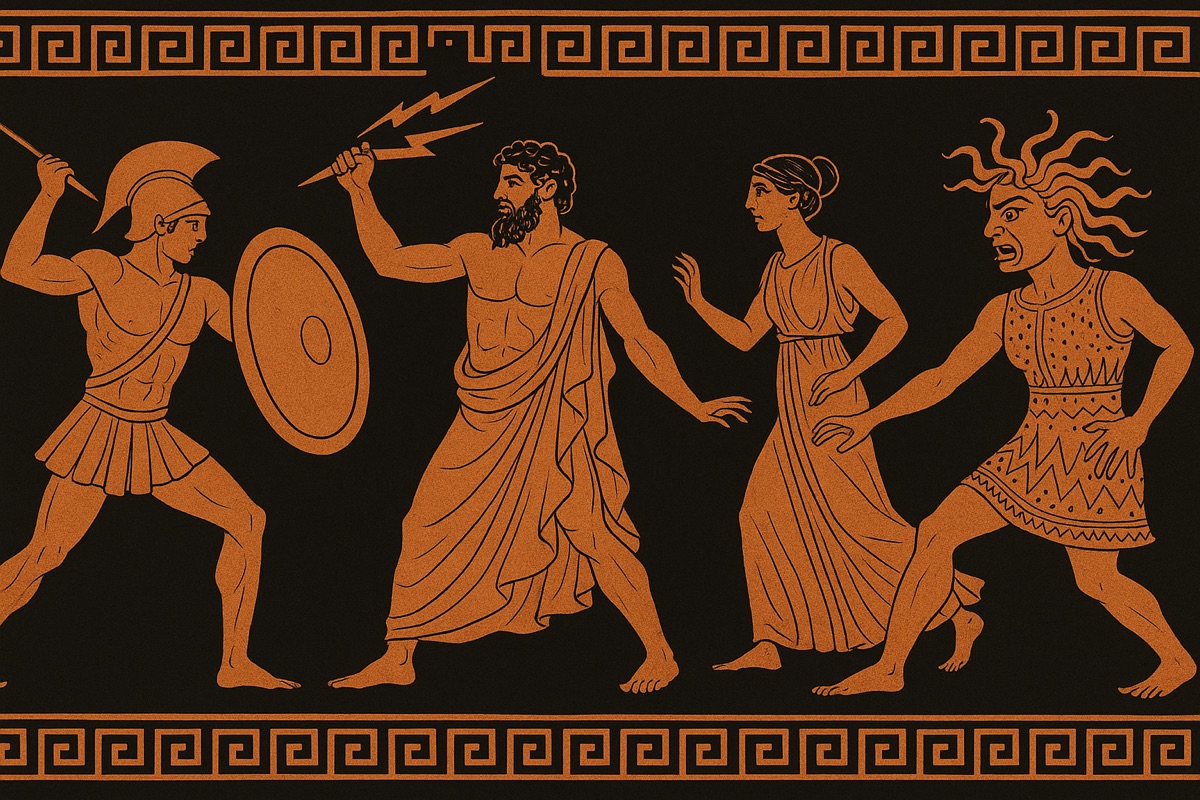
Medusa first. She's the famous one, but she had two sisters — the Gorgons were a trio. What made Medusa different from her siblings? She was the only mortal one, which is precisely why Perseus went after her instead of the other two. And how did he manage the decapitation without becoming a lawn ornament? He watched her reflection in his polished bronze shield — a workaround, not a cure, since her gaze still worked fine after death. He kept the head as a weapon.
Here's the round's argument-starter: does the Trojan Horse appear in the Iliad? Lock it in. It does not. The Iliad ends before the fall of Troy — the horse gets told later, in the Odyssey and, most fully, in Virgil's Aeneid. The most famous scene of the Trojan War isn't in the most famous poem about the Trojan War. Related twist: Achilles' vulnerable heel isn't in Homer either. In the Iliad he's simply a great warrior, not an invulnerable one — the dip-in-the-Styx story was attached centuries later. Trivia night is rarely ready for this.
Bonus round, no charge:
What three-headed dog guarded the entrance to the Greek underworld — and which hero had to fetch him as the last of the twelve labors?
Cerberus, dragged into daylight by Heracles. Capturing him was labor number twelve, the finale.
Round Three: The Norse Turn
North now, where the gods are doomed and know it. What did Odin trade for a drink from Mimir's well of wisdom? One of his own eyes. He also kept two ravens, Huginn and Muninn, who flew across the world each day and reported back. Their names translate, roughly, to Thought and Memory — the all-father ran an intelligence service.
Speaking of the family: name Thor's hammer. Mjölnir, obviously. But you're carrying more Norse mythology than you think — check your calendar. Thursday is Thor's day, Wednesday belongs to Odin (Woden), Tuesday to the war god Tyr, and Friday is generally traced to the goddess Frigg, though scholars still argue over whether it honors Frigg or Freyja. Either way, you invoke Norse gods four days a week.
Now the question this article promised you. Odin rides an eight-legged horse named Sleipnir, the best of all steeds. Who is Sleipnir's parent? Loki — and not as the father. Loki shapeshifted into a mare, distracted a giant's stallion, and later gave birth to Sleipnir himself. The trickster god is the mother of Odin's horse, and no, the myths do not treat this as especially remarkable. Loki's other children include Fenrir the wolf, Jörmungandr the world-serpent, and Hel, who rules the realm of the dead. Quite a household.
Last one, and it's the elite-tier fact: did all warriors who died in battle go to Valhalla? No — only half. The other half went to Fólkvangr, the field of the goddess Freyja, who by some tellings got first pick. Valhalla ran at fifty percent capacity, gathering fighters for Ragnarök — the prophesied end in which Odin himself falls to Fenrir. The Norse gods knew exactly how their story ended and showed up anyway, which might be the best trivia fact of all: the original mythology of going down swinging.
Tally it up. If you caught the jar, the missing horse in the Iliad, and Loki's unusual motherhood, you're ready to ruin any movie adaptation for everyone around you — as the gods intended.