Every day, pieces of the solar system fall on our heads, and every night a few of them put on a light show about it. These questions cover the rocks that made it all the way down — cover the answers, lock each one in, and keep score.
What's the difference between a meteoroid, a meteor, and a meteorite?
Location — a rock in space, the streak of light as it burns through the air, and whatever survives to the ground. Same pebble, three job titles.
How big is a typical "shooting star"?
Somewhere between a grain of sand and a pea — the brilliant streak is a speck hitting the atmosphere at tens of thousands of miles per hour.
How much space debris lands on Earth every day?
By NASA's estimate, roughly 48 tons — nearly all of it as dust you'll never notice on the car.
Who is the only person well documented to have been struck by a meteorite?
Ann Hodges of Sylacauga, Alabama — in 1954 an 8.5-pound stone crashed through her roof, bounced off the radio, and bruised her hip mid-nap.
In 1992, a meteorite in Peekskill, New York, punched through a parked 1980 Chevy Malibu. What happened to the car's value?
It soared — the owner had paid $300 for it; collectors bought the punctured Chevy for many times that, and it has toured museums ever since.
Why did nobody see the 2013 Chelyabinsk meteor coming?
It approached from the direction of the Sun, where telescopes are blind — then briefly outshone the Sun over Russia, and its shockwave shattered windows that injured about 1,500 people.
The 1908 Tunguska blast flattened some 80 million trees across hundreds of square miles of Siberia. What did searchers never find?
A crater — the object exploded in mid-air. Expeditions found scorched forest felled in a radial pattern with no hole at the center.
Where is the largest meteorite ever found, and why is it still there?
Hoba, in Namibia — roughly 60 tons of iron, never moved since its discovery in 1920. The atmosphere braked it so effectively it didn't even leave a crater to dig it out of.
What was Tutankhamun's finest dagger made of?
Meteoritic iron — a 2016 analysis of its nickel content matched iron meteorites, and Egyptian texts of the era call the metal "iron from the sky."
Arizona's Meteor Crater is three-quarters of a mile wide. What did mainstream science long insist had made it?
A volcanic explosion — mining engineer Daniel Barringer spent decades and a fortune arguing for an impact, and airtight proof only arrived in 1960.
What makes Antarctica the best meteorite-hunting ground on Earth?
Contrast and conveyor belts — dark rocks stand out on white ice, and flowing glaciers concentrate them in stranding zones. A large share of all collected meteorites come from there.
At the peak of the great Leonid storm of 1833, how many meteors fell per hour?
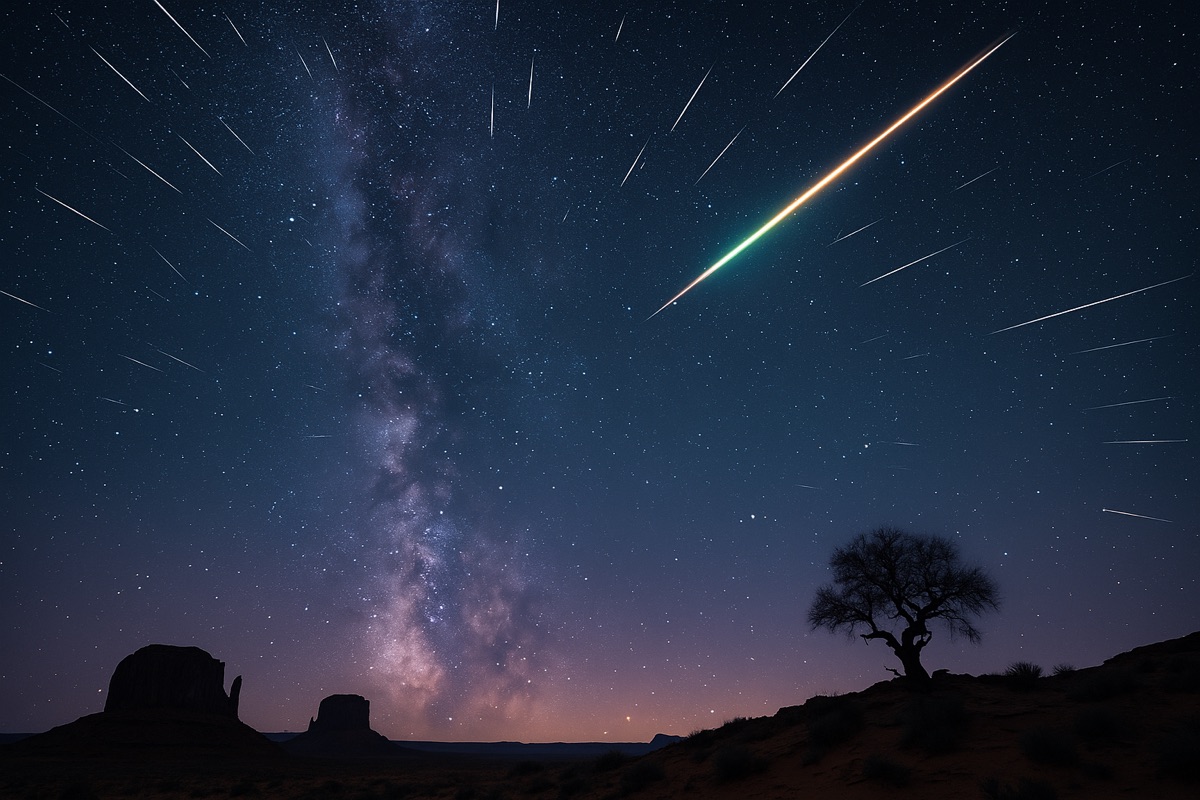
An estimated 100,000 — sleepers woke convinced the sky was on fire, and the night was still famous enough a century later to inspire the song "Stars Fell on Alabama."
What actually causes an annual meteor shower like the Perseids?
Earth plowing through a comet's debris trail — the Perseids are crumbs shed by comet Swift-Tuttle, arriving on schedule every August.
A stone that fell on the town of Ensisheim, France, in 1492 holds what distinction?
It's the oldest witnessed meteorite fall in the West with surviving material — hailed as a good omen for the king at the time, and still on display in town more than 500 years later.
How do we have pieces of Mars without ever flying a sample home?
Ancient impacts blasted rocks off Mars and the Moon, and some eventually landed here as meteorites. Free interplanetary shipping — the delivery times are just terrible.
If you knew the pharaoh's dagger and the $300 Chevy, take a bow — then maybe go check the roof.