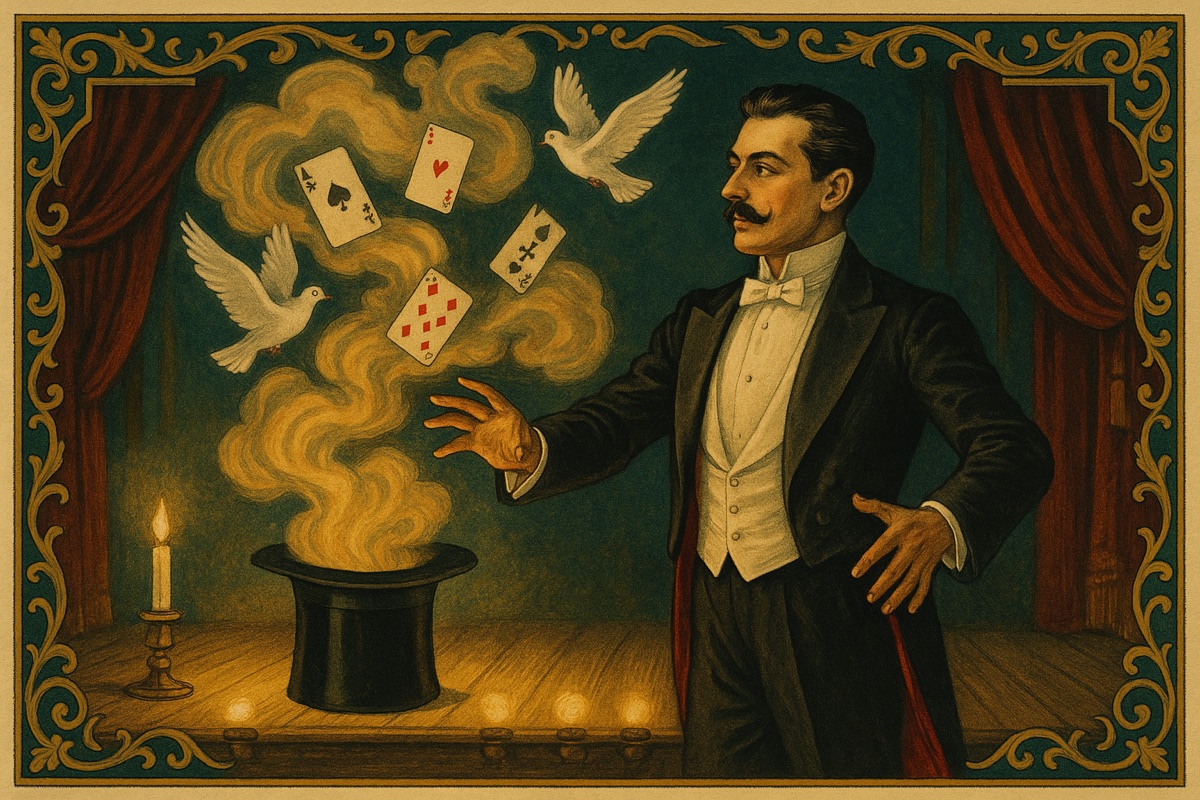
Stage magic runs on a strange contract: the audience pays to be lied to, and the performer risks everything to keep the lie beautiful. Three rounds of secrets follow — the names, the tricks that bit back, and the ones that fooled the professionals. Commit before each reveal and keep score; the magician's code says nothing about trivia.
Round One: The Name on the Marquee
Start with the title "father of modern magic." It belongs to Jean-Eugène Robert-Houdin, a nineteenth-century Frenchman whose first trade was — what? Lock it in. Clockmaking. He brought a watchmaker's precision to conjuring and made a bigger change still: he traded the wizard robes of the fairground for evening dress and moved magic into elegant theaters, where it has stayed ever since. His signature marvel was an automaton orange tree that blossomed and bore real fruit on command — clockwork doing the work of miracles.
His strangest booking came from the French government, which in 1856 sent him to Algeria to do what, exactly? Out-conjure the local holy men, whose displays of power France found politically inconvenient. His showstopper was the "light and heavy chest": a small box a child could lift until, at the magician's word, the strongest man in the room couldn't budge it. The secret was an electromagnet — cutting-edge physics wearing a sorcerer's costume.
Which brings us to the most famous stage name in history. A Budapest-born teenager named Erik Weisz idolized Robert-Houdin so completely that he added an "i" and became Harry Houdini — having been told, wrongly as it happens, that the suffix meant "like Houdin" in French. The romance didn't last: in 1908 Houdini published The Unmasking of Robert-Houdin, a book-length teardown of the man whose name he was still wearing. Magicians, like the rest of us, have complicated relationships with their heroes.
Round Two: The Tricks That Bit Back
January 1921, London: the magician P.T. Selbit debuted the illusion that would come to define the whole art form. What was it? Sawing through a woman. Selbit understood that the trick was only half the show — he reportedly had fake blood poured into the gutters outside theaters and ambulances parked at the curb. The stunt made the illusion a sensation, and rival magicians spent the next century inventing better ways to cut people in half and apologize afterward.
The deadliest trick, though, has always been the bullet catch, and its most famous casualty came in March 1918. The celebrated "Chinese" conjurer Chung Ling Soo was shot onstage in London when his trick rifle malfunctioned and fired a real bullet. The reveal made the tragedy stranger: Chung Ling Soo was actually William Robinson, an American from New York who kept his role so completely that he never spoke onstage — by most accounts, his cry of "Oh my God. Something's happened. Lower the curtain" was the first English his audiences had ever heard from him. He died the next day, having stayed in character nearly to the last.
Houdini's contribution to the big-illusion arms race was cheerier. In 1918, at New York's cavernous Hippodrome, he made what disappear? A full-grown elephant — Jennie, who vanished into a cabinet before thousands of witnesses. More than a century later, magicians still argue about exactly how he did it, which would have pleased him enormously.
Round Three: Fooling the Professionals
Houdini liked to boast that no one could fool him with the same trick three times. Who ended that streak in 1922 — with a single card trick? A young Canadian sleight-of-hand artist named Dai Vernon, who repeated his Ambitious Card — a chosen card that keeps rising to the top of the deck — over and over while Houdini fumed. Vernon billed himself as "The Man Who Fooled Houdini" for the rest of his long life, and the magic world still considers it the finest advertising line the art ever produced.
Now the oldest question in the act: where does "abracadabra" come from? Not from a magician — from a doctor. Nearly 1,800 years ago, the Roman physician Serenus Sammonicus prescribed the word as a cure for fever: written out in a diminishing triangle, losing a letter per line, and worn as an amulet so the illness would shrink away with the text. The most famous magic word in the world began as a prescription.
And the closer, which is really a handoff. In 1888, Robert-Houdin's old Paris theater was bought by a magician named Georges Méliès — who went on to carry stage illusion into which brand-new medium? Cinema. After seeing the first film projectors, Méliès discovered that the camera could do what no trap door could, pioneered the special effect, and eventually fired a rocket into the Moon's eye in A Trip to the Moon. Stage magic didn't fade in the twentieth century; it bought a camera.
Final tally. If you named the clockmaker, the unlucky bullet-catcher, and the man who fooled Houdini, you've earned the top hat — wear it to your next quiz night and refuse to reveal your sources.