Insects outnumber us, out-lift us, out-fly us, and have been running the planet's logistics since long before the dinosaurs. Fourteen questions from the small end of nature — answer each one before the reveal, keep score, and try not to take the ant round personally.
Round One: Feats of Strength
Open with the gym question. Roughly how much can an ant carry relative to its own body weight? Guess a multiple before you read on. Leafcutter ants can hoist around 50 times their own weight — the human equivalent of carrying a pickup truck over your head, uphill, in traffic. And they do it all day, in single file, without complaining.
Stay in the colony. How long can an ant queen live? Not weeks, not months — decades. Queens of some species have survived nearly 30 years in captivity, laying eggs the entire time, which makes them some of the longest-lived insects known.
Now the round's sting in the tail: what is the deadliest animal on Earth to humans? Not the shark, not the snake. It's the mosquito, whose diseases — malaria above all — kill hundreds of thousands of people every year. The most dangerous animal alive fits on your thumbnail.
Round Two: The Communicators
Here's the question that won somebody a Nobel Prize. How does a honeybee tell its hivemates where the good flowers are? It dances. The famous "waggle dance" encodes both the direction of the food (as an angle relative to the sun) and the distance to it — turn-by-turn navigation, performed in the dark, on vertical honeycomb. Karl von Frisch decoded it and shared the 1973 Nobel Prize for the discovery.
The bees are working with more information than you, by the way. What can bees see that humans can't? Ultraviolet light. Many flowers carry UV patterns — invisible to us — that work like runway markings pointing straight at the nectar. To a bee, a plain yellow flower is covered in signage.
Now calibrate your respect for honey. How much does a single worker bee produce in her entire lifetime? About one-twelfth of a teaspoon. Every jar in your pantry is the pooled life's work of thousands of bees. And one more light-based marvel: what's remarkable about the firefly's glow? Its efficiency — bioluminescence converts nearly all of its energy into light rather than heat, which is why fireflies are called "cold light" and your old incandescent bulbs, wasting most of their energy as heat, are called obsolete.
Round Three: Timekeepers and Aviators
The calendar question. Periodical cicadas in North America spend how long underground before emerging all at once? Thirteen or seventeen years, depending on the brood — and the fact that both numbers are prime is probably not an accident. The leading hypothesis: prime-number cycles make it mathematically hard for shorter-lived predators to sync their booms to the feast. The cicada, in other words, may have out-mathed its enemies while sitting in the dirt.
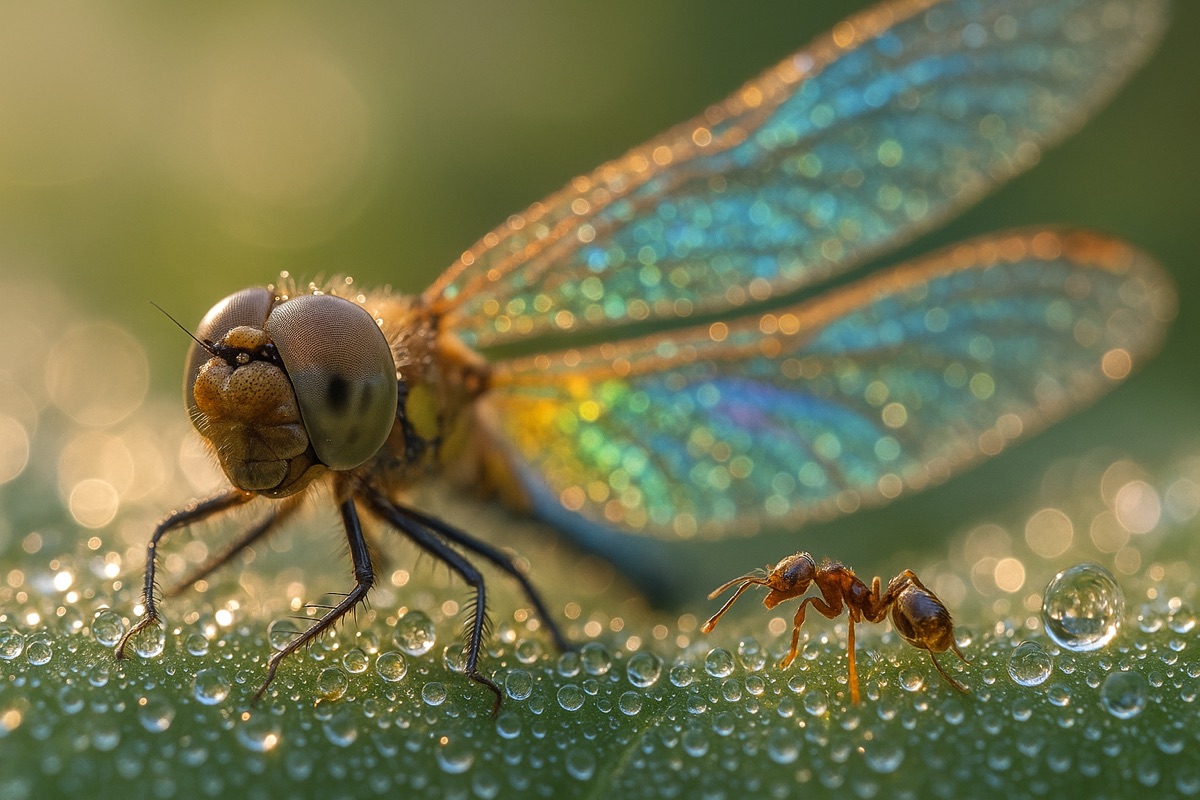
Now the fighter pilot. What is a dragonfly's hunting success rate? Take a guess — most predators are thrilled with one kill in three. Studies put dragonflies at up to 95 percent, likely the best hunters in the animal kingdom. The secret is engineering: each of its four wings is powered and controlled independently, allowing hovering, sharp turns, and flying backward. And this design is ancient — dragonfly relatives called griffinflies cruised the Carboniferous swamps some 300 million years ago with wingspans over two feet, back when higher oxygen levels let insects grow to nightmare scale.
Two closers. Monarch butterflies migrate up to 3,000 miles between Canada and Mexico — so how many generations does the round trip take? Several. The monarchs that fly south have never been there; their great-great-grandparents made the previous trip, yet they navigate to the same wintering forests. Nobody fully knows how, and "nobody fully knows how" is the best phrase in trivia. Finally, the biodiversity question: roughly what share of all known animal species are beetles? About one in four. The biologist J.B.S. Haldane, asked what nature revealed about its creator, supposedly quipped: "an inordinate fondness for beetles."
Count your score. If you got the prime-numbered cicadas, the 95-percent dragonfly, and the one-twelfth teaspoon, you're officially the person the table turns to when something small crawls by.