Dinosaur trivia has a secret advantage: almost everything you learned as a kid — or from a certain 1993 blockbuster — has since been revised, feathered, or flat-out debunked. That means the person who read one dinosaur article this decade beats the person who read twenty in 1995. Today, be the first person. Keep score; there are no participation trophies in the Cretaceous.
Round One: Deep Time Is Deeper Than You Think
Open with the fact that breaks brains. Which is closer in time to Tyrannosaurus rex: Stegosaurus, or you? Sit with it, commit, and then accept the answer: you. Stegosaurus lived in the late Jurassic, roughly 150 million years ago. T. rex didn't show up until about 68 million years ago — meaning more than 80 million years separate those two dinosaurs, while only 66 million separate T. rex from your kitchen. Every toy box that poses them together is a chronological crime scene.
The framework behind that fact: name the three periods of the age of dinosaurs. Triassic, Jurassic, and Cretaceous — together the Mesozoic Era. Dinosaurs dominated for something like 165 million years. For scale, our species has existed for around 300,000. We are the new hires loudly redecorating the office.
And the ending: what ended the reign, and where did it hit? An asteroid roughly six miles wide, about 66 million years ago, striking near what is now the Yucatán Peninsula in Mexico. The buried scar it left is called the Chicxulub crater, and it's the rare trivia answer you can still point to on a map.
Round Two: The Movies Lied to You
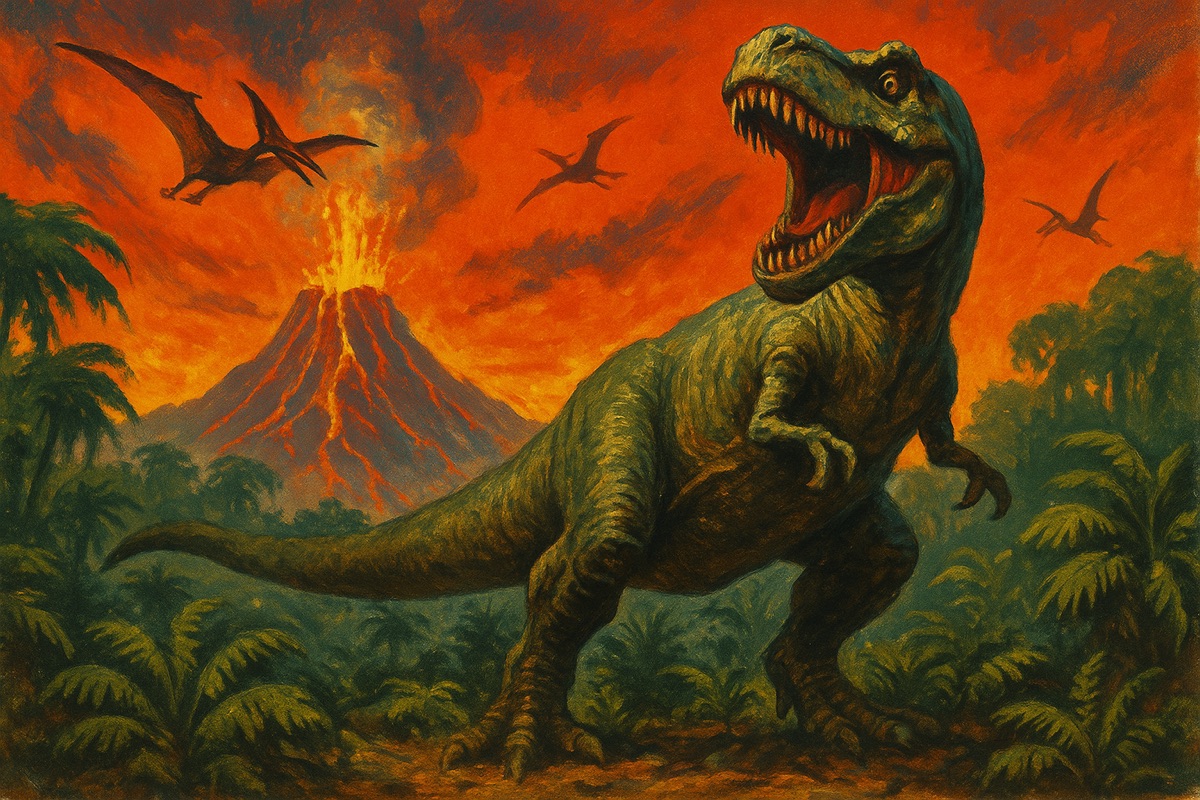
Now the fun part. True or false: T. rex couldn't see you if you didn't move. False — gloriously false. That idea is pure Hollywood. Modern analysis of T. rex's forward-facing eyes suggests it had excellent binocular vision, with depth perception rivaling a hawk's and, by some estimates, visual acuity many times sharper than a human's. Standing very still in front of a real T. rex would have accomplished exactly one thing: making yourself easier to aim at.
Next: how big was an actual Velociraptor? Picture it, then shrink your picture. The real animal was about the size of a turkey — and it had feathers. The tall, scaly kitchen-stalkers of the movies were modeled far more closely on Deinonychus, a bigger North American cousin. So the films got the menace right, the name and the wardrobe wrong.
Keep the streak going: were pterodactyls dinosaurs? No — pterosaurs were flying reptiles, cousins of dinosaurs but not members of the club. Same for the great marine reptiles like mosasaurs and plesiosaurs. Dinosaurs, strictly speaking, were a land-dwelling group. The sky and sea monsters were the extended family crashing the reunion.
One credit where due, though: T. rex's bite lives up to the hype. Estimates put its bite force at several tons — the strongest known of any land animal ever, capable of crunching straight through bone. The movies undersold its eyes and oversold nothing about its jaws.
Round Three: Superlatives and Comebacks
Biggest first. What kind of dinosaur was the largest ever to walk the Earth? The titanosaurs — long-necked giants like Argentinosaurus and Patagotitan, with the biggest estimated at over 100 feet long and somewhere around 60 to 70 tons, though estimates from partial skeletons come with honest error bars. Now the follow-up that wins the round: has any animal ever, in the entire history of life, been heavier? Yes — the blue whale, which is alive right now. The largest animal of all time isn't in a museum; it's in the ocean.
Small-brain corner. Stegosaurus was the size of a bus and had a brain about the size of a walnut. For decades, textbooks claimed it compensated with a 'second brain' in its hips. That one's a myth — the cavity in its hip region likely held tissue or fat stores, not a backup brain. One walnut had to run the whole bus.
Comeback story: what happened to Brontosaurus? In 1903, scientists decided it was really just Apatosaurus and struck the name from the books — museums relabeled, a generation mourned. Then in 2015, a major analysis of the family tree concluded Brontosaurus was distinct after all, and the name came thundering back. If you spent decades smugly correcting people who said Brontosaurus, science has humbled you, and this author respects your loss.
Last question, and it's the big one: did the dinosaurs actually go extinct? Not all of them. Birds are living theropod dinosaurs — direct descendants of the same group that included Velociraptor and T. rex. The asteroid ended the giants, but the lineage never broke. Every pigeon eyeing your sandwich is a dinosaur running a 66-million-year-old survival streak.
Count your score. If you got the Stegosaurus time gap, the turkey-sized raptor, and the walnut-brained bus, you're officially more current than the movies — and you have a moral obligation to say 'actually, birds are dinosaurs' at least once this week.