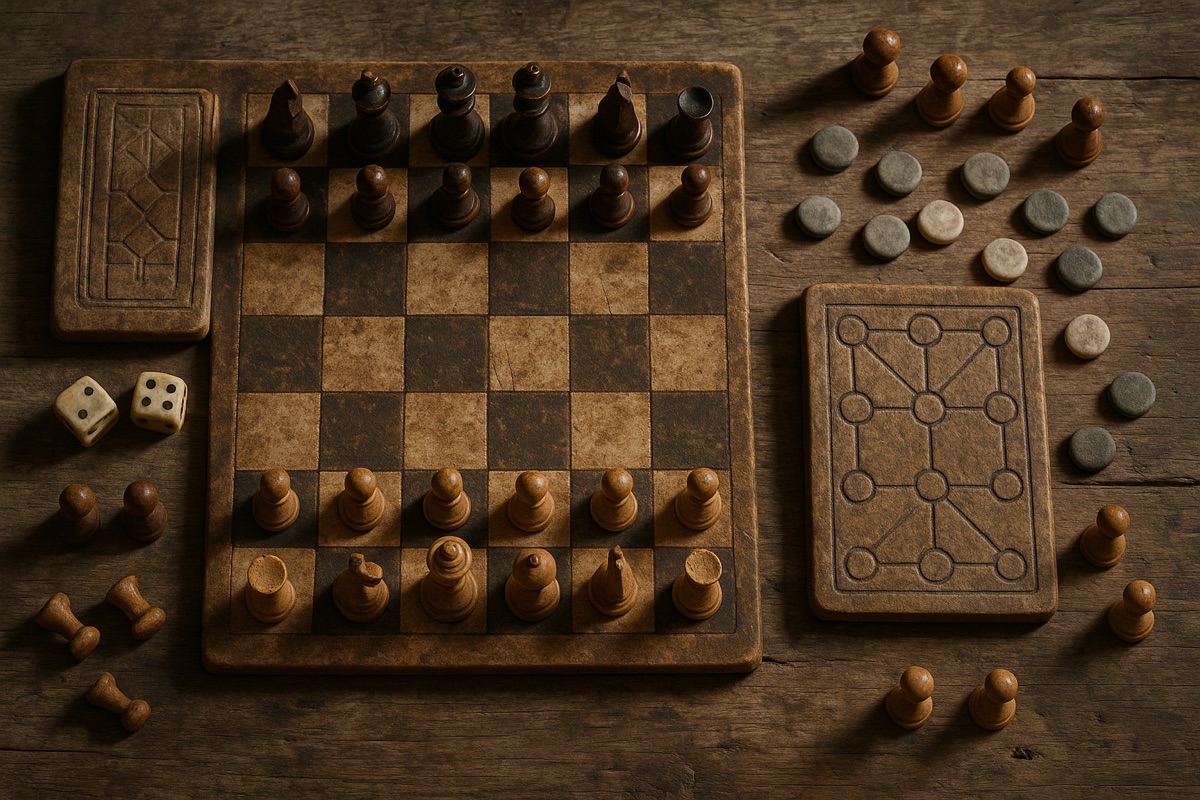
Humans have been pushing pieces around boards for about as long as we've had cities — and the games that survived carry better stories than most history books. This round runs from a pharaoh's tomb to a Depression-era architect's kitchen table. Answer out loud before each reveal, and keep score like your rating depends on it.
Round One: The Ancient Shelf
Start at the very beginning. What Egyptian game, played as far back as roughly 5,000 years ago, is among the oldest board games ever found? That's senet, a race game on a grid of thirty squares. Egyptians took it seriously enough to paint it on tomb walls, and multiple senet boards were buried with Tutankhamun — apparently even the afterlife deserved a game night.
Mesopotamia answers with our next question. The Royal Game of Ur, dug up from tombs around 4,500 years old, comes with a bonus fact that sounds invented: how do we know its rules? A British Museum curator matched the boards to a much later Babylonian clay tablet that actually describes the play — making it perhaps the oldest game whose written rules survive. You can lose a 4,500-year-old game, correctly, today.
Now the deep end. The game of Go, born in China well over two thousand years ago, is played with simple black and white stones on a 19-by-19 grid — so how complicated can it be? Try this: the number of legal board positions in Go dwarfs the number of atoms in the observable universe. It isn't close. Simplest equipment in this article, biggest number, which is exactly the kind of joke mathematics likes to play.
Round Two: The Chess Round
Where did chess come from? Not Europe. Its ancestor, chaturanga, arose in India roughly 1,400 years ago, then traveled through Persia — where it became shatranj — before reaching Europe with the Arab world. The Persian leg of the journey survives every time you win: "checkmate" descends from the Persian shah mat, generally rendered as "the king is helpless." You've been speaking Persian at the game table your whole life.
Here's the twist most players never learn. The queen — the strongest piece on the modern board — began as what? A weak advisor, the vizier from the older game, hobbling one diagonal square at a time. Only in late 15th-century Europe did the piece acquire its sweeping modern powers, a rules change so dramatic that the fast new game got nicknames amounting to "mad queen chess." The most feared piece in the game is, historically speaking, the new kid.
And one for the road out of this round: which morality-lesson race game did the British adapt from India, where ladders stood for virtues and snakes for vices? Snakes and Ladders — a game about karma that arrived in America with the snakes swapped out for chutes.
Round Three: The Modern Classics
Scrabble first. Who invented it, and how did the letters get their point values? An out-of-work architect named Alfred Mosher Butts, during the Great Depression — and he set the values and letter counts by painstakingly tallying letter frequency from pages of newspapers, including The New York Times. That's why common E costs you one point and rare Q and Z pay ten: the scoring is a hand-built census of the English language.
Next, a gentler origin than you'd guess. Candy Land was designed in the 1940s by Eleanor Abbott while she was recovering from polio — created to entertain children on polio wards, kids who needed a game with no reading and no strategy, just color and luck. The sweetest board in the toy aisle started as hospital equipment.
Murder now. Cluedo — Clue in America — was dreamed up by what sort of inventor, and when? An English factory worker and music fan named Anthony Pratt, who worked it up in Birmingham during the Second World War and patented it in the 1940s; it reached shelves in 1949. A game about a country-house murder, conceived while actual bombs fell — escapism doing exactly its job.
Last question, and it's the heist. Monopoly is credited to Charles Darrow, who sold it to Parker Brothers in the 1930s — but the game descends from whose earlier invention? Elizabeth "Lizzie" Magie, whose Landlord's Game, patented back in 1904, was designed to teach players how rent enriches landlords and impoverishes tenants. Her anti-monopoly teaching tool evolved, hand to hand and board to board, into the most famous celebration of monopoly ever sold. She received a few hundred dollars; the irony compounds annually.
Score yourself. If you landed the Persian checkmate, the mad queen, and Lizzie Magie, you may pass Go — and you already know better than to collect only the credit Darrow got.