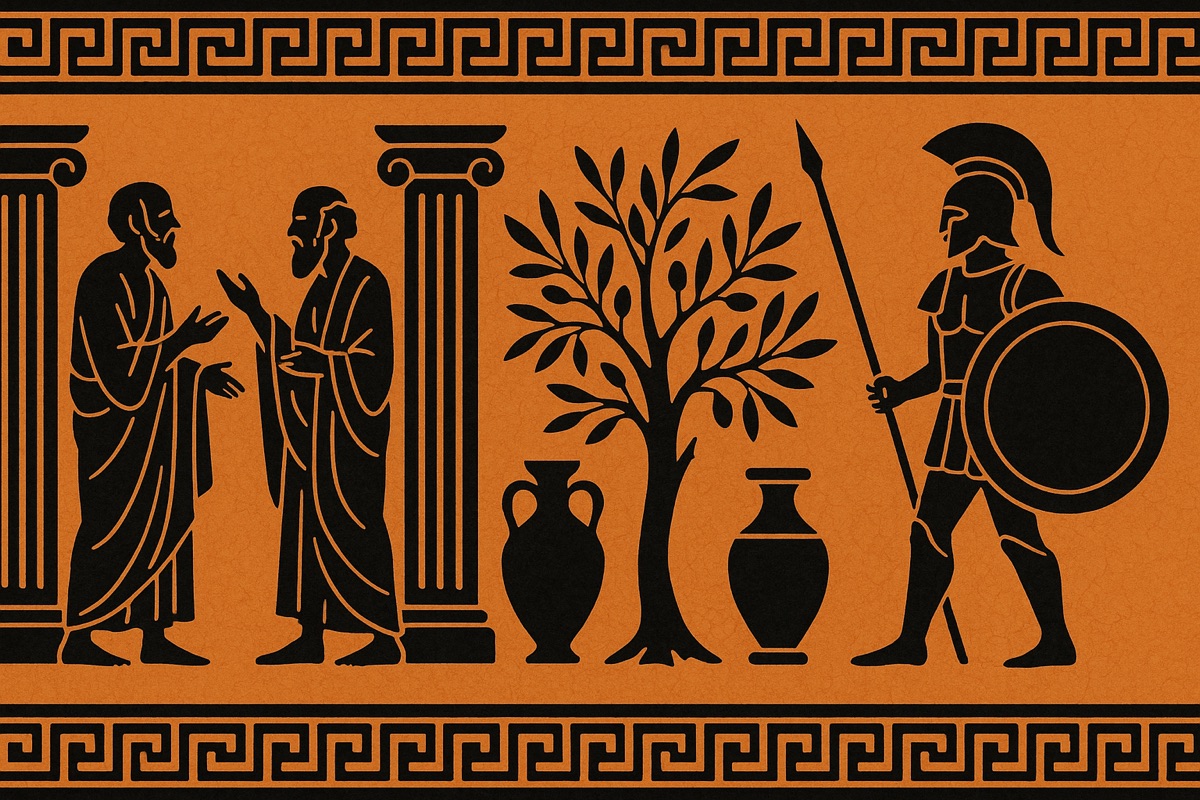
Ancient Greece invented democracy, philosophy, and the word for nearly everything — then let the marble statues do the talking. The details are stranger and funnier than the postcard version. Three rounds follow: commit to each answer before the reveal, keep score, and remember that the Greeks considered competition next to godliness.
Round One: Democracy, Now With a Lottery
Start with how Athens actually filled government jobs. Elections, surely? Mostly no — most public offices were assigned by drawing lots. To Athenians, elections smelled aristocratic, since they favored the rich and famous, while a lottery of ordinary citizens was democracy in its purest form. They did elect their generals, on the sensible theory that war was the one job you shouldn't win by luck.
Next: what was ostracism, originally? Once a year, Athenians could vote to banish one man from the city for ten years — no charge, no trial, no appeal. Each voter scratched a name onto a pottery shard called an ostrakon, which is exactly where the word “ostracize” comes from. And here's the detail that makes the whole system human: archaeologists in Athens found 190 shards bearing the name of the statesman Themistocles — written in just a handful of handwritings. Someone had mass-produced attack ballots and handed them out. Negative campaigning is older than paper.
So who actually got a vote? Adult male citizens only — by most estimates somewhere between 10 and 20 percent of the people living in Athens. Women, foreigners, and the enslaved were all shut out. As for the citizen who could participate but couldn't be bothered, the Greeks had a word for such a purely private person: idiotes. It is the direct ancestor of the modern word you're thinking of. The insult sharpened over the centuries, but the disapproval came pre-installed.
Round Two: Philosophers Behaving Badly
How many books did Socrates — arguably the most famous philosopher who ever lived — write? Zero. Not a page. Everything we know arrives secondhand, mostly through his student Plato, which means Western philosophy's founding voice is technically hearsay. Plato, for his part, taught in an olive grove sacred to a hero named Academus — his school, the Academy, is why anything scholarly is still called “academic.”
Now the round's star: Diogenes the Cynic, who made poverty a performance art and lived in a large ceramic jar in the marketplace. When Alexander the Great — the most powerful man alive — stood before him and offered to grant any wish, Diogenes asked him to step aside, because he was blocking the sunlight. And when Plato defined man as a “featherless biped,” Diogenes, as the ancient biographers tell it, turned up holding a plucked chicken and announced: behold, Plato's man. The Academy amended its definition.
Alexander connects to one more: which philosopher tutored him as a teenager? Aristotle — meaning the man who conquered the known world did his homework for the man who catalogued it. And a daily-life closer: the famous Greek symposium literally means “drinking together,” but the wine was always cut with water. Drinking it neat marked you as a barbarian — a word the Greeks coined because foreign languages sounded to them like “bar-bar” babble.
Round Three: War Stories and Ancient Machines
Sparta first. At what age did a Spartan boy leave home for full-time military training? Seven — into the brutal state system called the agoge. Plutarch records the send-off attributed to Spartan mothers: come back with your shield, or on it.
Now the correction everyone needs. Was Thermopylae really 300 men against an empire? Not quite. The force holding the pass numbered roughly 7,000 Greeks from many cities, and on the final day the famous 300 Spartans stood alongside about 1,100 Thespians and Thebans who stayed to the end. The movie is missing several thousand extras — and the Thespians deserve their credits.
Related: did a runner really sprint about 25 miles from Marathon to Athens, gasp out news of victory, and die? Lock in your answer. The oldest source tells a different — and better — story. Herodotus has the courier Pheidippides run from Athens to Sparta, roughly 150 miles in about two days, to beg for help before the battle. The die-at-the-finish version only appears in writers centuries later. The truer feat is six marathons back to back, and the runner lived.
Finish with the machines. In 1901, sponge divers exploring a shipwreck off the island of Antikythera hauled up a corroded bronze device that turned out to contain dozens of precision interlocking gears — a roughly 2,000-year-old mechanism that modeled the sun and moon and predicted eclipses. It's routinely called the world's first known analog computer, and nothing of comparable complexity shows up in the record for well over a thousand years. And the Greek engineer Hero of Alexandria described a coin-operated dispenser for holy water — drop in a coin, receive your portion. The vending machine is older than the printing press by about 1,400 years.
Tally it up. If you caught the government by lottery, the plucked chicken, and the 150-mile run, you've out-argued the postcard version of Greece — and somewhere, Diogenes would still find something to heckle.